
More Information
Submitted: August 19, 2026 | Accepted: August 29, 2026 | Published: August 31, 2026
Citation: Sangtiani Ak, Khan B, Javed S, Aamir S. Targeted Therapies and Imaging Biomarkers: Revolutionizing ITP and Coronary Inflammation Management. J Community Med Health Solut. 2026; 7(2): 96-98. Available from:
https://dx.doi.org/10.29328/journal.jcmhs.1001081
DOI: 10.29328/journal.jcmhs.1001081
Copyright license: © 2026 Sangtiani AK, et al. This is an open access article distributed under the Creative Commons Attribution License, which permits unrestricted use, distribution, and reproduction in any medium, provided the original work is properly cited.
Keywords: Precision medicine; Rilzabrutinib, Immune thrombocytopenia (ITP); BTK inhibitor; Pericoronary adipose tissue (PCAT); Coronary inflammation

Targeted Therapies and Imaging Biomarkers: Revolutionizing ITP and Coronary Inflammation Management
Aneesh Kumar Sangtiani1* , Barina Khan2, Sundal Javed3 and Sariya Aamir4
1Department of Public Health, Dow University of Health Sciences, Baba-E-Urdu Road, Karachi 74200, Pakistan
2Department of Public Health, Karachi Medical and Dental College, Karachi, Pakistan
3Department of Public Health, Dow International Dental College, Dow University of Health Sciences, Pakistan
4Department of MBBS, liaquat university of medical and health sciences, Jamshoro 71000, Pakistan
*Corresponding author: Aneesh Kumar Sangtiani, Dow University of Health Sciences, Baba-E-Urdu Road, Karachi 74200; Pakistan, Email: [email protected]
Precision medicine is increasingly shaping clinical practice in both hematology and cardiology by promoting therapies and diagnostics rooted in disease mechanisms. In immune thrombocytopenia (ITP), rilzabrutinib, an oral Bruton tyrosine kinase inhibitor, represents a targeted strategy that addresses key drivers of the disease. By reducing autoantibody production and limiting immune-mediated platelet destruction, it has demonstrated sustained platelet responses while potentially avoiding the broader immunosuppressive effects seen with conventional treatments. Its mechanism also raises the possibility of application in other autoimmune conditions.
In cardiology, attention has turned toward pericoronary adipose tissue (PCAT) attenuation measured on coronary computed tomography angiography as a marker of coronary inflammation. Unlike traditional imaging that focuses primarily on luminal narrowing, PCAT assessment offers insight into vascular inflammatory activity and may enhance cardiovascular risk prediction.
Although these developments are promising, important challenges remain, including long-term tolerability, cost considerations, and technical standardization. Together, these advances reflect both the opportunities and the complexities involved in translating precision medicine from theory into everyday clinical care.
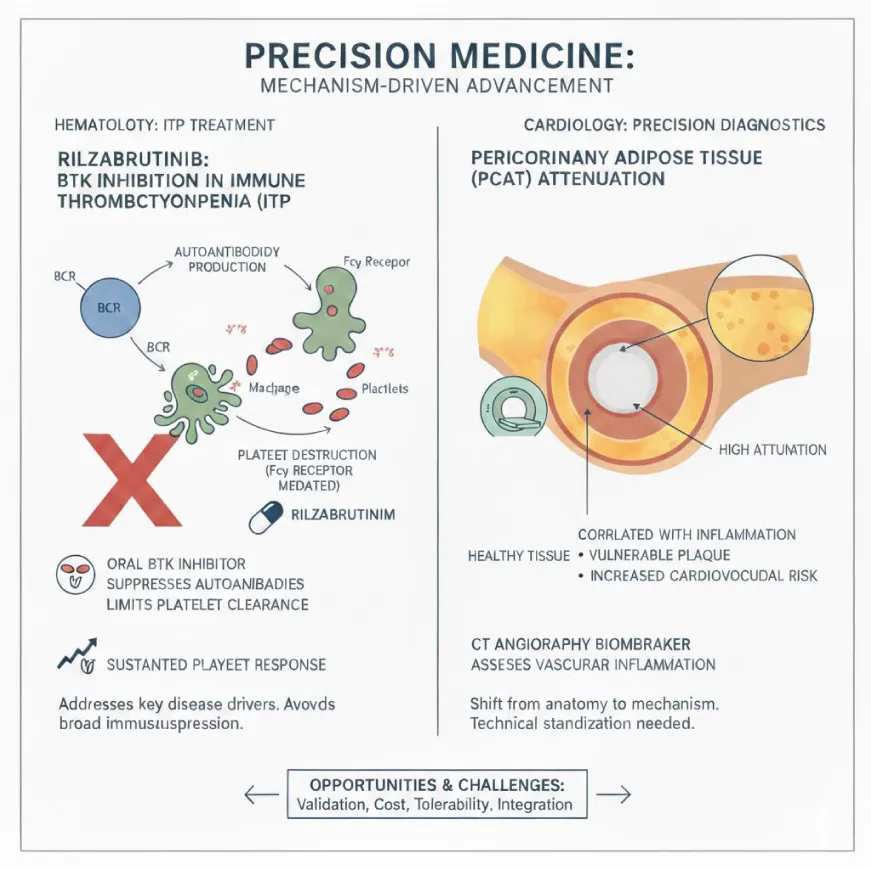
Graphical Representation
Amid growing global advancements in patient care worldwide, we are seeing incredibly promising outcomes for treatments in hematology and cardiology. Two outstanding breakthroughs must be mentioned. The first addresses a long-standing need for a novel drug that targets the complex pathophysiology of Immune Thrombocytopenia (ITP), previously untapped by standard drugs. Rilzabrutinib, an FDA-approved orally administered, reversible, and potent covalent Bruton tyrosine kinase (BTK) inhibitor, has been developed. When taken as a 400 mg twice-daily oral dose shows a quick and stable platelet count increase in patients diagnosed with chronic ITP [1]. Secondly, in the cardiology sphere, we are seeing an increased interest in the Pericoronary Fat Attenuation Index (FAI) as a coronary inflammation predictor. Pericoronary FAI is evaluated via coronary computed tomography angiography and has surfaced as a modern imaging biomarker [2]. Both diseases have immune-mediated inflammatory activity as a key pathophysiological mechanism, though there is a clinical distinction. Rilzabrutinib is an example of a drug that directly targets this ITP immune dysregulation, while pericoronary FAI provides a non-invasive way of capturing local immune-inflammatory activation in the vascular wall of coronary disease. Together, they illustrate two complementary facets of precision medicine, one interventional, one diagnostic, anchored in a shared focus on inflammation as a modifiable and measurable target.
Corticosteroids and IVIG are still considered first-line treatments for a quick rise in platelets, but they are not intended to maintain remissions. Thrombopoietin receptor agonists (TPRAs) increase platelet production in chronic maintenance therapy, and second-line B-cell-depleting agents such as rituximab provide more durable treatment, but are associated with delayed onset of action and/or treatment burden or inconsistent long-term efficacy. Rilzabrutinib, a novel approach in targeting the two prime drivers of the disease, suppresses autoantibody production by B cells and inhibits Fcγ receptor-mediated platelet clearance by macrophages [3]. These mechanisms suggest a specific and targeted strategy compared to other conventional immunosuppressants.
The most compelling evidence so far was presented by the phase 3 LUNA3 trial. Rilzabrutinib patients had increased rates of sustained platelet responses, decreased bleeding events, and decreased use of rescue therapy. Early response usually predicted long-term outcome, with consequences for the feasibility of biomarker-guided therapy. Safety findings were reassuring, as always, but the issue of tolerability in the long run and relative to established treatments like rituximab and TPO receptor agonists [4].
Aside from ITP, inhibition of BTK also points towards the pathway’s broader immunomodulatory function. By blocking both the adaptive and the innate response simultaneously, rilzabrutinib may reduce generalized immunosuppression from traditional medications, though this remains to be confirmed in comparative studies. The model proposes potential for the extension of BTK-targeted treatment to other autoimmune illnesses with related pathophysiology [3,4].
The same precision paradigm is coming down the pike in cardiology, but in diagnostics. Pericoronary adipose tissue (PCAT) attenuation measured by computed tomography (CT) has been proposed as an imaging marker for coronary inflammation that is noninvasive. Increased PCAT attenuation is correlated with vulnerable plaque and poor cardiovascular outcomes, offering information not provided by traditional angiography [5]. But the technique is bedeviled by technicalities: attenuation values are reconstruction algorithm-dependent, and reproducibility across scanners is unreliable, restricting its use in direct clinical application [6].
The two collectively show the direction hematology and cardiology are headed in mechanism-based precision medicine. BTK inhibition demonstrates the potential for how targeted drugs can revolutionize autoimmune disease therapy, and PCAT imaging shows how personalized diagnostics can tailor cardiovascular risk stratification. Both hold promise, but success is up to extensive validation, equal access, and integration into current clinical pathways [4–6].
In conclusion, the advent of rilzabrutinib and PCAT-based imaging heralds a shift toward precision medicine across specialties. Rilzabrutinib is considered more effective as it offers superior targeting for ITP over traditional immunosuppressants, with rapid responses and biomarker-guided therapy, though long-term tolerability relative to rituximab or TPO agonists warrants further study. Its immunomodulatory profile also suggests broader applications in autoimmunity. Similarly, in cardiology, PCAT attenuation analysis illustrates how inflammation-focused imaging biomarkers may refine cardiovascular risk assessment beyond conventional anatomical evaluation, but technical variability and reproducibility challenges limit routine use. Although challenges related to long-term tolerability, technical standardization, and cost remain, these innovations collectively underscore a pivotal shift from generalized treatment models to individualized, pathophysiology-oriented care. Ultimately, realizing precision medicine’s promise hinges on rigorous validation, equitable access, and seamless integration into clinical practice.
Availability of data and materials
No primary data or database was used in preparing the manuscript.
Author contribution
All authors contributed to the conception, drafting, and critical revision of the Letter to the Editor. All authors approved the final version of the manuscript and agreed to be accountable for all aspects of the work.
- Kuter DJ, Ghanima W. Evaluating rilzabrutinib in the treatment of immune thrombocytopenia. Immunotherapy. 2025 Jul;17(11):767-782. Available from: https://doi.org/10.1080/1750743x.2025.2545170
- Sun JT, et al. Pericoronary fat attenuation index is associated with vulnerable plaque components and local immune-inflammatory activation in patients with non-ST elevation acute coronary syndrome. J Am Heart Assoc. 2022 Jan;11(2):e022879. Available from: doi:10.1161/JAHA.121.022879.
- Kuter DJ, et al. Rilzabrutinib, an oral BTK inhibitor, in immune thrombocytopenia. N Engl J Med. 2022 Apr;386(15):1421-1431. Available from: https://doi.org/10.1056/nejmoa2110297
- Kuter DJ, et al. Safety and efficacy of rilzabrutinib vs placebo in adults with immune thrombocytopenia: the phase 3 LUNA3 study. Blood. 2025 Jun;145(24):2914-2926. Available from: https://doi.org/10.1182/blood.2024027336
- Yu X, Botezatu S, Tzolos E, Dey D, Kwiecinski J. Pericoronary adipose tissue computed tomography attenuation in coronary artery plaque inflammation. Heart. 2023 Mar;109(6):485. Available from: https://doi.org/10.1136/heartjnl-2022-321158
- Lyon AR, et al. 2022 ESC Guidelines on cardio-oncology developed in collaboration with the European Hematology Association (EHA), the European Society for Therapeutic Radiology and Oncology (ESTRO) and the International Cardio-Oncology Society (IC-OS). Eur Heart J. 2022 Nov;43(41):4229-4361. Available from: https://doi.org/10.1093/eurheartj/ehac244